|
Wisconsin LECET
|
|
Wisconsin LECET
|
| Training Takes on
Added Importance The Business Roundtable, a prestigious group of the CEOs of the 200 major U.S. industrial companies, has elevated the importance of training of construction craft workers up to the level of importance of jobsite safety. The Roundtable is urging owners to make such training mandatory in order for contractors to be prequalified for projects. The problem lies mostly with the open shop sector of the industry, which has trained craft workers every which way or not at all. And paying for training has been an intractable problem for non-union contractors for many, many years. Now the Business Roundtable will require contractors to train in order to be prequalified, and, contractors will remain responsible for the cost. Owners should only do business with contractors who invest in training and maintain the skills of their workforce. Maintaining a skilled workforce is mandatory. |
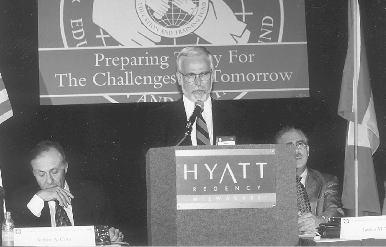
Michael R. Ryan President and Business Manager of Wisconsin Laborers District Council, welcomes the participants to the 1997 Laborers-AGC National Training Conference in Milwaukee. LIUNA General President Arthur A. Coia is seated at the left. It is necessary to provide cost effective construction. Continually updating and improving training programs will also be required. These requirements and this philosophy have been the foundation for training in the unionized sector of the construction industry for many years. In fact, laborers and signatory contractors from across the country confirmed our commitment to training in Wisconsin late this summer. The 1997 National Laborers-AGC Education and Training Fund's annual conference was hosted by the Wisconsin Laborers District Council and the Wisconsin Laborers Skill Improvement Fund in Milwaukee at the end of August. And to demonstrate our level of commitment to training, the conference focused on implementing a strategic plan that will guide Laborers training well into the next century. The conference served as an opportunity to examine and discuss the goals and objectives of the Strategic Plan. The plan had been developed after a carefully conceived needs assessment and committee work process that included focus groups to generate ideas and suggestions, a written survey to identify current and future training needs and input gathered from workshops at the Tri-Fund Conference earlier this year. The completed Strategic Plan for Laborers Training is the vision for the future. All totaled, nearly 1000 individuals contributed to its creation. The plan will grow, and ultimately succeed, only through the continued participation of all individuals and organizations affected. The Mission Statement for the Strategic Plan reads: The mission of Laborers training and education is to improve the quality of life for Laborers International Union of North America (LIUNA) members and expand the the competitive position of union employers. The seven critical Initiatives and action plans from A Strategic Plan for Laborers' Training are detailed beginning below. |
| 1. CURRICULUM DEVELOPMENT AND DELIVERY a. Create a process to develop curriculum that considers existing and emerging markets and accesses and uses many resources (e.g., contractors, manufacturers and Laborers) in producing materials. b. Form a diverse and comprehensive industry committee to help set priorities and monitor curriculum development. c. Implement use of instructional technologies, such as computer-based instruction, CD-ROM, distance learning, and videos. Incorporate visuals, languages, and learning-style information into materials. Enable affiliated funds to use the technologies to deliver training. d. Improve standardization of curriculum by working through the Directors Development Program and the Instructor Development Program to ensure that materials are adopted and used in a consistent manner. 2.
FUNDING AND FINANCIAL MANAGEMENT 3. LIFELONG LEARNING 4. MARKETING, RECRUITMENT, AND RETENTION
5. ORGANIZATIONAL COMMUNICATION,
COORDINATION, AND COOPERATION 6. SKILL STANDARDS DEVELOPMENT AND
IMPLEMENTATION 7. TOTAL QUALITY MANAGEMENT |
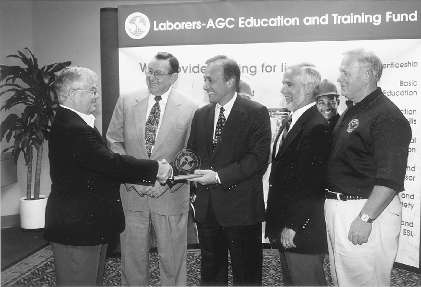 |
Wisconsin accepted one of its many awards in front of the Laborers-AGC Education and Training Fund trade show booth. Taking part in the presentation are from left: Dean Jensen, Director of the Wisconsin Laborers Training Center; Robert B. Fay, Sr., Co-Chairman, Laborers-AGC Education and Training Fund Board of Trustees; Arthur A. Coia, Co-Chairman, Laborers-AGC Education and Training Fund Board of Trustees and LIUNA General President; Mike Ryan, President and Business Manager, Wisconsin Laborers District Council; and Russell Leaman, Wisconsin Laborers Skill Improvement Fund Trustee. |
| WISCONSIN TRAINING PROGRAMS
WIN AWARDS Training programs developed by the Wisconsin Laborers Skill Improvement Fund received Innovation in Training Awards at the 1997 National Laborers-AGC Training Conference in Milwaukee. In the category of Training - Training Materials, the Wisconsin Laborers District Council, through the efforts of Business Manager and President Mike Ryan, was recognized for a joint training project with Operating Engineers Local 139. Training consisted of two 4-day hands-on sessions in trenching and building site excavation. Both the Laborers and the Operating Engineers called the training "the most realistic training they had ever received." Also in the category of Training - Training Materials, the Wisconsin Laborers Training Center trained 500 Laborers in traffic control and flagging procedures. Besides the manual, the course included day and night video presentations and a 150-foot model roadway complete with miniature signs, barricades, flaggers and machinery. The model allows trainees to set up real-life situations and make presentations to the class. The course traveled around the State of Wisconsin bringing hands-on training to thirteen local unions and the signatory highway contractors. In the category of Administration - Promotion and Recruitment, the Wisconsin Laborers Skill Improvement Fund, in conjunction with the Wisconsin Laborers District Council, the Wisconsin Laborers Training Center and Wisconsin LECET promoted the productivity of their signatory contractors and their skilled workforce using a new trade show booth. The booth showcases labor-management cooperation, worker health and safety, and apprenticeship and training. Also in the category of Administration - Promotion and Recruitment, Laborers Local 464 in Madison, along with the Madison Area Technical College, the Construction Labor-Management Council of Madison and the Wisconsin Laborers Training Center held 8-week construction career opportunity programs for high school students. The programs included hands-on experience with a building tradesperson and, with the assistance of Local 464 Business Manager Robert Niebuhr, promoted on-site visits to the Wisconsin Laborers Training Center. Upon completion of the program, the students worked for the City of Madison and gained firsthand knowledge regarding employer expectations and work ethics. In the category of Administration - Linkages with Other Organizations, the Wisconsin Laborers District Council and the Wisconsin Road Builders Association partnered with the Federal Highway Administration, the State of Wisconsin Department of Transportation, the YWCA of Greater Milwaukee Consortium and the Wisconsin Laborers Training Center to create the TrANS 90 Program. This program was an intensive two-week industry awareness class providing orientation and introduction to the road construction industry. Pre-construction training included classes in Construction Craft Laborer orientation, OSHA construction safety, commercial driver's license exam preparation, traffic control and flagging, and on-the-job training on community improvement projects. Also in the category of Administration - Linkages with Other Organizations, the Wisconsin Laborers Skill Improvement Fund partnered with the Wisconsin Laborers Training Center, the Milwaukee Community Service Corps, the Wisconsin Laborers District Council and Laborers Local 113 to train corps members in general construction, concrete practices, mason tending and scaffolds. Once trained, corps members worked on community improvement projects. After completing their training with the service corps, the trainees became members of Laborers Local 113. In the categories of Training - Training Materials and Administration - Linkages with Other Organizations, Laborers Local 113 in Milwaukee partnered with LIUNA, HUD, the Wisconsin Laborers District Council, the Milwaukee Public Housing Authority and the Wisconsin Laborers Training Center in the Public Housing Apprenticeship Demonstration Program in the Construction Trades. The program consisted of five weeks of training in general construction, concrete practices, mason tending, scaffolds and lead abatement. This training was followed by seven weeks of community projects for the City of Milwaukee. Twenty young people--ages 18 to 24--who are full-time residents of public housing, were trained. |
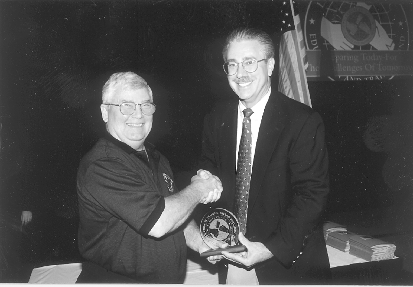 |
Dean Jensen (left), Director of the Wisconsin Laborers Training Center, is congratulated by James "Mitch" Warren, Executive Director of the Laborers-AGC Education and Training Fund, after receiving one of Wisconsin's Innovation in Training awards. |